Finding the best China jewelry manufacturers for local jewelers requires more than comparing factory prices. Product consistency, communication, documentation, and realistic lead times matter equally. The World Gold Council’s Gold Demand Trends 2024 reported continued pressure on Chinese jewelry demand, despite strong gold prices. This environment makes accurate costing and flexible production especially important.
China remains a major jewelry manufacturing center, supported by experienced workshops, advanced casting equipment, and mature supply networks. However, capability varies widely between factories. Some specialize in sterling silver, while others handle gold, stainless steel, lab-grown stones, or custom private-label collections. The Responsible Jewellery Council emphasizes responsible sourcing, business integrity, and supply-chain controls. Local jewelers should therefore request material certificates, stone disclosures, production samples, and clear quality procedures before placing an order.
Trust matters.
A reliable manufacturer should explain minimum order quantities, plating thickness, mold fees, inspection steps, and after-sales responsibilities. CIBJO standards and recognized gemological documentation can help buyers assess product descriptions more carefully. Yet no report can replace direct experience. A polished website may hide weak finishing or inconsistent sizing. I have seen supplier evaluations fail because buyers checked only photographs and quotations. The better approach combines factory audits, sample testing, video inspections, and small trial orders. This guide compares practical factors that help local jewelers identify suitable Chinese manufacturing partners, while acknowledging one uncomfortable truth: the cheapest supplier is rarely the lowest-risk supplier.
China’s jewelry manufacturing scope looks substantial against the World Gold Council’s 2,092.6-tonne global jewelry demand baseline for 2023. WGC data separates consumer demand from mine supply, so this figure does not measure factory output directly. It does, however, show the scale of the market serving manufacturers, wholesalers, and local jewelers.
China Gold Association reported domestic gold consumption of 1,089.69 tonnes in 2023, including 706.48 tonnes of gold jewelry. These figures suggest strong demand for casting, CAD design, chain production, stone setting, polishing, and small-batch customization.
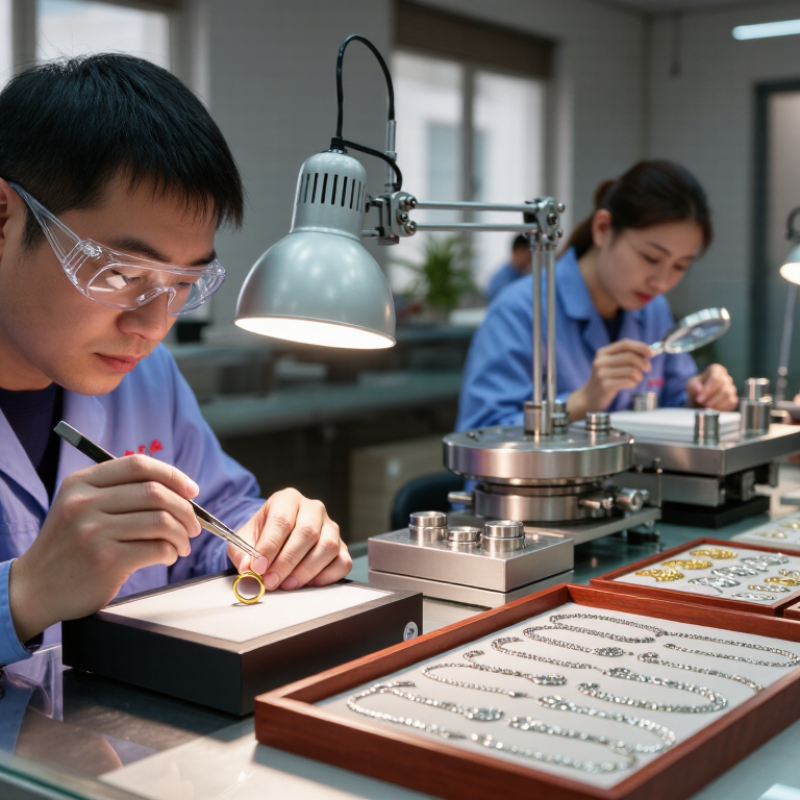
A local jeweler can request a 3D sample, inspect a wax model, and review finishing before approving production. Practical checks matter. Ask for metal assay records, stone-setting inspection, production tolerances, and batch photographs. Supplier audits also help verify workshop equipment and quality procedures.
The baseline is useful, but it is not a factory capacity figure. That distinction is easy to miss. Manufacturing volume varies by metal, order size, design complexity, and seasonal pressure. The World Gold Council also recorded meaningful recycled-gold flows in 2023, reminding buyers that material sourcing affects cost and traceability.
In practice, the strongest manufacturing relationship may not be the largest one. It may be the workshop that documents corrections, communicates delays early, and consistently reproduces a 10-millimetre setting without visible movement.
Choosing the best China jewelry manufacturer requires more than checking a catalog. In sourcing reviews, I compare minimum order quantity, lead time, production capacity, and export records together. A factory offering a 50-piece MOQ may suit local jewelers testing a new collection. However, low MOQs can increase unit costs and reduce material choices. Ask for sample timing, remake policy, and recent production photos. Real details matter.
Lead time should include sampling, approval, production, inspection, and shipping. For standard silver pieces, 15 to 30 production days is a useful planning range. Custom gold designs often require longer scheduling. Capacity claims need evidence, such as monthly output records, equipment lists, and peak-season delivery history. The World Gold Council reported total gold demand of about 4,975 tonnes in 2024, showing strong pressure across global supply chains. Capacity without quality control is not capacity.
Export data offers another reliability check. Review HS Code 7113 records through UN Comtrade or ITC Trade Map, then compare shipment frequency, destination markets, and declared product value. Export volume alone can mislead. It may reflect one large contract rather than stable service. I also check whether factory documents match the exporting entity. That step is often missed. A manufacturer with a longer lead time may still be safer when inspection access, traceability, and communication are stronger. My own comparison sheets are never perfect; supplier data changes quickly, and quoted capacity should be verified before payment.
Best China Jewelry Manufacturers for Local Jewelers?
A manufacturer’s certificate is only a starting point. Local jewelers should request batch-level evidence for gold, silver, and gemstones. ISO 11426 supports gold testing through cupellation, while ISO 11427 covers silver analysis by volumetric methods. An ISO/IEC 17025-accredited laboratory should issue the report. Check the laboratory name, sample weight, testing date, and fineness result. Do not accept a scanned certificate without traceable batch details.
RJC criteria add wider controls beyond metal purity. Its Code of Practices covers responsible sourcing, human rights, environmental management, and supply-chain due diligence. The 2024 World Gold Council demand report recorded 4,974 tonnes of total gold demand in 2023, including recycling. This scale makes documented sourcing important. The Silver Institute’s World Silver Survey 2024 reported industrial silver demand of about 654.4 million ounces in 2023. Silver content and recycled inputs therefore deserve separate verification.
For gemstones, ask for treatment disclosure, weight, dimensions, and an independent identification report. A loupe, density test, or supplier statement is not enough. In factory audits, small details often expose weak controls: mixed parcels, unclear lot numbers, or inconsistent plating thickness. RJC alignment helps, but it does not replace laboratory testing. Certificates can also be outdated. That is easy to overlook. A practical approval file should connect the purchase order, production sample, test report, and final inspection photographs. Mistakes still happen, especially when buyers trust paperwork more than physical evidence.
For local jewelers, the best China jewelry manufacturers should offer more than competitive pricing. OEM capability matters when you need stable specifications, repeatable sizing, and packaging that matches your retail process. Ask whether the factory can manage CAD files, prototypes, stone setting, surface finishing, and production records. A clear sample approval process is essential.
Custom design requires practical communication. Share sketches, reference measurements, stone preferences, and target costs before development begins. Review the CAD model and physical sample carefully. Small details matter, such as prong height, clasp tension, polish quality, and the weight of a finished pendant. A supplier may accept complex ideas, but not every idea will manufacture efficiently. That limitation should be discussed early.
Quality control should include material verification, dimensional checks, stone matching, plating inspection, and final batch sampling. Request photographs, inspection reports, and clear defect standards. Independent testing can help verify metal purity or gemstone information when the order is commercially important. Certification should be current, traceable, and relevant to the product and market. Do not accept a certificate without checking its issuing body and scope. A polished presentation can still hide weak controls. No factory is flawless. The real test is how openly it handles failed samples, delayed production, or corrective work. A small pilot order often reveals more than a confident sales call.
| Anonymous Supplier Profile | OEM Production | Custom Design Capability | Typical MOQ | Sample Lead Time | Bulk Lead Time | Quality-Control Process | Material & Product Testing | Certification Evidence to Request | Best Fit for Local Jewelers | Overall Assessment |
|---|---|---|---|---|---|---|---|---|---|---|
| Profile A Integrated precious-jewelry factory |
Excellent Private-label production, CAD-to-production workflow, packaging support, and repeat-order management. |
Excellent In-house CAD, 3D modeling, wax/resin prototyping, stone-setting revisions, and design confidentiality procedures. |
Usually 30–100 pieces per style; lower quantities may be possible for development samples. | 7–15 working days after artwork approval. | 25–45 working days, depending on metal, stone availability, and order complexity. | Incoming material inspection, first-piece approval, in-process checks, final inspection, weight verification, and photo records. | Metal purity testing, gemstone inspection, plating-thickness checks, solder-joint inspection, and finished-piece dimensional checks. | ✓ ISO 9001 certificate scope ✓ Recent third-party audit ✓ Independent precious-metal test reports △ Responsible-sourcing documentation |
Local jewelers needing consistent private-label collections and frequent design changes. | High suitability |
| Profile B Mid-sized silver and vermeil specialist |
Strong Good repeatability for established styles, standard packaging, and small-to-medium production runs. |
Strong CAD outsourcing may be combined with internal sample review; suitable for moderately complex designs. |
Usually 50–200 pieces per style. | 10–20 working days after confirmed drawings. | 20–40 working days for standard designs. | Pre-production sample approval, random final inspection, visual finish checks, and order-count reconciliation. | Silver or gold-plating checks, surface-finish inspection, clasp and chain-function testing, and basic nickel/lead/cadmium screening when requested. | ✓ Material declarations ✓ Batch test reports △ ISO 9001 evidence should be checked by certificate number △ Social-compliance audit availability varies |
Retailers focused on silver, vermeil, fashion jewelry, and manageable minimum order quantities. | Good suitability |
| Profile C High-volume fashion-jewelry producer |
Strong Efficient for catalog-based items, standardized components, and large repeat orders. |
Standard Can modify existing molds and components; fully original designs may require external development support. |
Usually 200–500 pieces per style; lower MOQs are less economical. | 12–25 working days. | 25–50 working days, with longer timing during peak seasons. | Production-line inspection, carton sampling, visual grading, and quantity checks; documentation depth should be confirmed before ordering. | Plating adhesion, color consistency, basic component function, and restricted-substance testing when included in the purchase order. | ✓ Factory audit reports may be available △ ISO or social-compliance certificates require independent verification △ Product testing is often order-specific |
Local jewelers with predictable high-volume demand and price-sensitive collections. | Good for volume |
| Profile D Small-batch artisan workshop |
Standard Flexible for small runs, handmade details, repairs, and limited-edition collections. |
Strong Direct communication with craftspeople can support design adjustments and handmade finishes. |
Usually 10–50 pieces per style. | 10–25 working days, depending on prototype revisions. | 30–60 working days for small-batch production. | Manual inspection, maker review, sample comparison, stone-setting inspection, and final visual approval. | Testing capability may be outsourced; request metal assay, plating, gemstone, and restricted-substance reports for each relevant batch. | △ Workshop registration documents △ Outsourced laboratory reports △ Formal management-system certification may not be available |
Boutiques and independent jewelers that prioritize uniqueness, craftsmanship, and low-volume launches. | Moderate suitability |
| Profile E Export-oriented multi-category manufacturer |
Strong Experienced with export documentation, retail packaging, barcode systems, and multi-market orders. |
Standard Design development is available, but engineering and sampling capacity may vary by product category. |
Usually 100–300 pieces per style. | 10–20 working days. | 25–45 working days after sample sign-off. | Documented inspection checkpoints, export packing checks, carton drop testing, and pre-shipment inspection options. | Material declarations, plating checks, dimensional checks, packaging tests, and third-party laboratory testing by request. | ✓ Export documentation ✓ Third-party inspection access △ ISO 9001 or ISO 14001 status must be verified △ RJC or equivalent responsible-sourcing claims require current evidence |
Retailers requiring organized international shipping, packaging compliance, and scalable replenishment. | Good suitability |
| Profile F Component and semi-finished jewelry supplier |
Limited Best suited to findings, chains, charms, beads, and semi-finished components rather than complete collections. |
Standard Useful for component customization, dimensions, plating, and logo stamping. |
Usually 100–1,000 pieces per component, depending on tooling requirements. | 7–18 working days. | 20–40 working days. | Dimension checks, surface inspection, plating-color comparison, count verification, and packaging checks. | Metal composition, coating adhesion, clasp function, dimensions, and restricted-substance testing as specified. | ✓ Material composition reports △ Factory-level certification may not cover every component △ Request batch-specific laboratory evidence |
Local workshops and jewelers assembling or finishing products in-house. | Niche suitability |
For local jewelers, the best China jewelry manufacturer is not always the cheapest quote. A dependable supplier should provide recent factory audit records, production photos, and clear ownership details. Request an audit dated within twelve months. Check worker safety, quality control, and subcontracting practices. One polished document proves little. Verify the address through a video call or independent inspection.
Samples reveal what spreadsheets hide. Order pieces using the exact metal, plating thickness, stone size, clasp, and packaging you plan to sell. Weigh each item and compare it with the approved drawing. Ask for material test reports from a qualified laboratory. Keep one sealed sample for future comparison. Ask for evidence. A beautiful prototype can still conceal slow replies or inconsistent batch control.
Calculate landed cost, not only unit price. Include samples, molds, inspections, freight, duties, payment fees, repairs, and delays. Ask for minimum orders, lead times, tiered pricing, and a written replacement policy. Score suppliers by quality, communication, capacity, documentation, and shipping exposure. Keep records. A risk register helps identify backup suppliers and reorder points. No scorecard is perfect. Reassess performance after every production run, because factory conditions and service quality can change.
With our award-winning goldsmiths, the end result will be a tailor-made heirloom you and your loved ones will treasure for generations. Together we walk through the design process. We listen to you carefully. Discuss what you want and what you don’t, and provide an excellent collaborative experience to bring your vision to life.
From the moment you walk in, you are treated like family. We will make your jewelry shopping experience easy and help you find the perfect piece.