Choosing the best diamond jewelers in China takes more than comparing a bright stone under showroom lights. Buyers also need clear grading, reliable after-sales service, and pricing they can understand. The market deserves careful context. Bain & Company estimated that China’s personal luxury goods market contracted by 12% in 2023, to approximately RMB 369 billion. Its China Luxury Goods Market study shows why jewelers must earn trust, not merely rely on brand recognition.
A strong comparison should examine diamond documentation, craftsmanship, return policies, and repair support. The Gemological Institute of America’s 4Cs—cut, color, clarity, and carat weight—offer a recognized framework for evaluating diamonds. Ask whether a certificate matches the stone, and whether staff explain its limits in plain language. Small details matter: a written resizing policy, a secure setting, or a clear answer about a grading report. That is useful, but not the whole story. A certificate cannot tell you whether a ring feels right for daily wear.
This guide considers established brands and specialist retailers across China, while distinguishing verifiable facts from marketing claims. It does not treat popularity as proof of quality. Store standards can vary, even within one chain, and online listings may leave important questions unanswered. Some judgments remain subjective. The aim is practical: help readers compare diamond jewelers with better questions, credible sources, and realistic expectations before making a significant purchase.
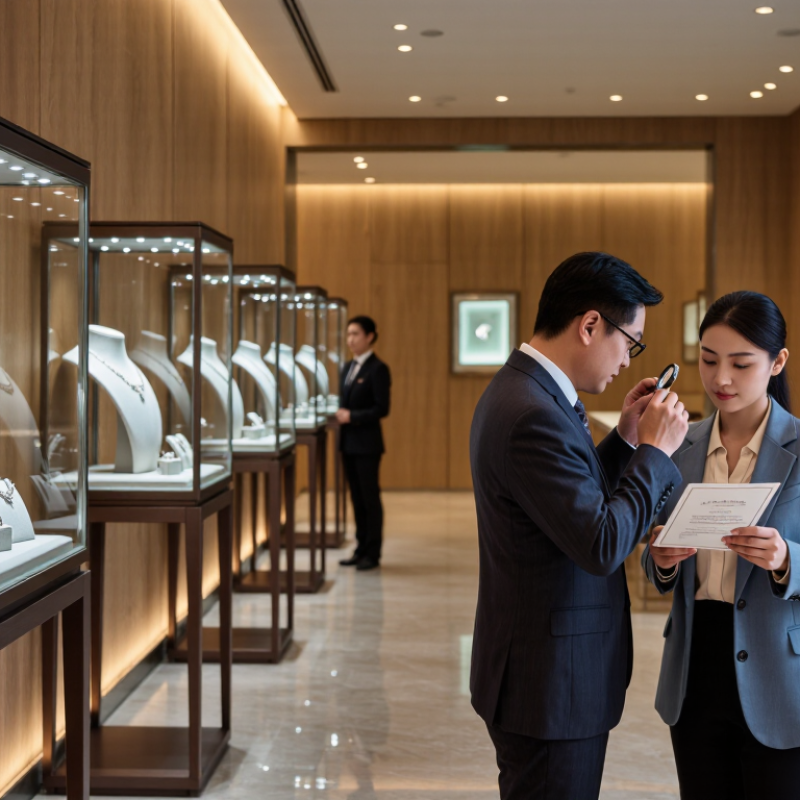
China’s diamond trade needs clear, comparable descriptions. GB/T 16554-2017 provides a national framework for grading diamonds, covering features such as color, clarity, cut, and carat weight. Implemented in 2018, it gives jewelers and buyers shared terms for discussing a stone. Small differences matter.
Bain & Company’s 2022 Global Diamond Industry Report estimated worldwide diamond-jewelry retail sales at about US$95 billion. In a market of that scale, consistent grading helps buyers compare stones more carefully. Ask for documentation that identifies the grading standard and matches the diamond’s weight and measurements. Then inspect the stone under neutral lighting. Look closely.
A grading report is useful, but it cannot capture every visual impression. Two diamonds with similar grades may return light differently in a display case. Cut quality, setting, and lighting all affect what the eye sees. Grades guide a decision; they do not replace it.
In China, diamond shoppers may compare three retailers with different strengths. One large national chain offers broad store access and many price points. Another tends to pair diamond pieces with contemporary designs. A heritage-focused jeweler may appeal to buyers who value traditional styling and established craftsmanship. These are general impressions, not guarantees; collections vary by branch and season. Look closely.
Tips: Ask to see the diamond’s grading report, and check whether its details match the stone. Compare cut, color, clarity, and carat weight together. A bright stone under shop lighting can look different beside a window. Keep the receipt and written care terms.
The best choice depends on the piece, not just the name above the door. Try on similar settings and notice whether prongs catch on a knitted sleeve. Ask how resizing or routine cleaning is handled. Staff explanations can be useful, but verify important claims in writing. I would not assume a higher price means better value; comparing equivalent specifications takes patience, and sometimes the differences are less obvious than expected.
When comparing diamond jewelers in China, begin with a grading report and the details behind it. GIA’s 4Cs—cut, color, clarity, and carat weight—offer a consistent way to assess a stone. They do not tell the whole story. Cut affects how brightly a diamond returns light, while carat measures weight, not visible size. For round brilliant diamonds, GIA provides a cut grade; other shapes require closer visual comparison.
Clarity has 11 grades, from Flawless and Internally Flawless through VVS, VS, and SI levels to I1, I2, and I3. Graders assess inclusions and blemishes under 10× magnification. A tiny mark may be hard to see without a loupe, yet its position can affect appearance or durability. Look at the diamond in ordinary lighting, too. That matters. A report helps, but it cannot show exactly how a mounted stone looks on your hand.
Ask to examine the report number and confirm that it matches the diamond being offered. Compare stones of similar carat weight, then notice differences in brightness, color, and visible inclusions. Do not pay more for a higher clarity grade automatically; some inclusions are not visible without magnification. I would pause over any comparison made only from enlarged photographs. They can make small features look dramatic, or hide how a stone performs in person.
When comparing diamond jewelers in China, compare stones with similar cut, color, clarity, and carat weight. Lab-grown diamonds often cost substantially less than comparable natural diamonds, but the price gap varies by quality and market conditions. Both are diamonds; their origin differs. A lower price alone does not prove a better purchase. Check how the stone looks under daylight, not only beneath bright shop lights.
Disclosure deserves equal attention. Ask for the origin, any treatments, grading details, and a written price breakdown covering the stone and setting. A grading report can help, but check that its number matches the diamond being sold. Look closely at the return terms and warranty, too. Clear answers matter. If a seller cannot explain whether a stone is natural or lab-grown, pause before paying. I would also compare the same specifications across several shops, though online listings can leave out details that change the real value. A careful jeweler makes those details easy to inspect.
| Comparison Point | Natural Diamond | Lab-Grown Diamond | What a Trustworthy Seller Should Disclose |
|---|---|---|---|
| Origin | Formed naturally beneath the Earth over geological timescales. | Produced using technological processes, commonly high-pressure high-temperature (HPHT) or chemical vapor deposition (CVD). | State the diamond’s origin clearly before purchase; do not describe a lab-grown diamond as natural. |
| Material and appearance | Crystalline carbon with the same basic chemical composition and crystal structure as lab-grown diamond. | Crystalline carbon with the same basic chemical composition and crystal structure as natural diamond. The two generally cannot be distinguished by sight alone. | Explain that origin is not reliably established by visual appearance and may require appropriate gemological testing. |
| Indicative price comparison | Usually costs more than a lab-grown diamond with comparable carat weight and grading characteristics. Actual prices vary substantially. | Often priced substantially below a comparable natural diamond; the discount is not fixed and varies by market, specification, and seller. | Provide the actual price in the offer and identify the stone being compared. Treat broad percentage comparisons as indicative, not guaranteed quotations. |
| Factors that affect price | Carat weight, cut, colour, clarity, grading report, shape, and market conditions all influence price. | The same grading characteristics affect price; production method, supply, and market conditions may also influence the offer. | Show the relevant specifications and explain whether the quoted price includes the setting, tax, resizing, or other services. |
| Grading and documentation | A grading report may document characteristics such as carat weight, colour, clarity, and cut. Reports and grading approaches can differ. | A report may document comparable gemological characteristics and identify the stone as laboratory-grown. | Let buyers review the report, verify its report number with the issuing laboratory, and check that the stone matches the report. |
| Disclosure on the invoice or certificate | Documentation should identify the stone as natural and accurately describe its stated specifications. | Documentation should identify the stone as lab-grown, laboratory-grown, or synthetic diamond, rather than leaving its origin ambiguous. | Make origin, carat weight, any grading-report details, and the item being sold clear in the written sales documents. |
| Resale and value expectations | Resale value is not guaranteed and may be lower than the original retail price; offers depend on the stone and market. | Resale value is also not guaranteed and may be affected by changing supply and prices in the lab-grown market. | Avoid guaranteed investment or buyback claims unless the terms are written, specific, and independently verifiable. |
| How to compare jewelers | Compare stones with similar carat weight, shape, cut, colour, clarity, and documentation. | Compare lab-grown stones with similar specifications and check that each offer clearly states laboratory-grown origin. | Assess written disclosure, report verification, itemized pricing, return terms, and after-sales policies—not price alone. |
Note: This is a general comparison, not a live price survey or a ranking of individual jewelers. Diamond prices vary by specification, seller, and date; request a current written quotation for the exact stone.
A reliable diamond jeweler makes certification easy to verify, not merely impressive to read. Ask for an independent grading report and compare its details with the stone, including its carat weight, cut, color, and clarity. If the diamond has a laser inscription, check that its report number matches. A report describes a stone; it does not guarantee that every buyer will value it the same way. Keep the paperwork.
Pricing should be clear before you pay. Request an itemized quote showing the diamond, setting, taxes, and any fees for resizing or delivery. Ask whether the quoted price changes if you choose a different metal or setting. Vague answers are worth noting. One easy mistake is focusing on a discount while overlooking what the price includes.
After-sales service matters once the ring is on your hand. Check the written terms for resizing, repairs, routine cleaning, and warranty coverage, including any conditions or time limits. Ask who handles service and how long a typical repair takes. Keep written replies, not just verbal promises. A polished showroom can feel reassuring, but it is not a substitute for clear service terms. If an answer remains unclear, pause and ask again.
A practical framework for evaluating certification, pricing transparency, and after-sales service
Certification receives the highest proposed weight, followed by pricing transparency and after-sales service. These percentages are an editorial scoring framework, not survey results or ratings of specific jewelers. Check each jeweler’s documentation, itemized pricing, and written service terms before purchasing.
With our award-winning goldsmiths, the end result will be a tailor-made heirloom you and your loved ones will treasure for generations. Together we walk through the design process. We listen to you carefully. Discuss what you want and what you don’t, and provide an excellent collaborative experience to bring your vision to life.
From the moment you walk in, you are treated like family. We will make your jewelry shopping experience easy and help you find the perfect piece.