
Why Choose Freeze-Dried Strawberries for Your Business? The answer begins with changing consumer expectations. Shoppers want convenient fruit with recognizable ingredients, bright flavor, and minimal preparation. Freeze-Dried Strawberries can meet those needs while offering practical advantages for manufacturers, retailers, and foodservice operators.
Market data supports this direction. Grand View Research reported that the global freeze-dried food market was valued at approximately USD 2.9 billion in 2023. Its analysis also projects steady growth through 2030, supported by demand for lightweight, shelf-stable foods. Fortune Business Insights similarly identifies convenience, longer storage, and expanding snack applications as key market drivers. These reports differ in their market boundaries and forecasts. The numbers are not a guarantee. That distinction matters.
In real business settings, product performance becomes visible quickly. A handful of Freeze-Dried Strawberries adds color to granola, yogurt, chocolate, cereal, and bakery toppings. The pieces remain light during transport and can be stored without conventional refrigeration when properly packaged. They also provide a crisp texture that fresh or frozen fruit cannot consistently deliver. However, quality still depends on variety, ripeness, drying controls, moisture protection, and packaging design. A weak moisture barrier can soften the fruit within days. That is easy to overlook.
For buyers, the strongest decision combines sensory testing, supplier verification, nutrition review, and cost analysis. Reliable documentation should cover ingredients, processing conditions, allergen controls, and storage guidance. Choosing well means more than following a trend. It means selecting a fruit ingredient that performs clearly in a real product.
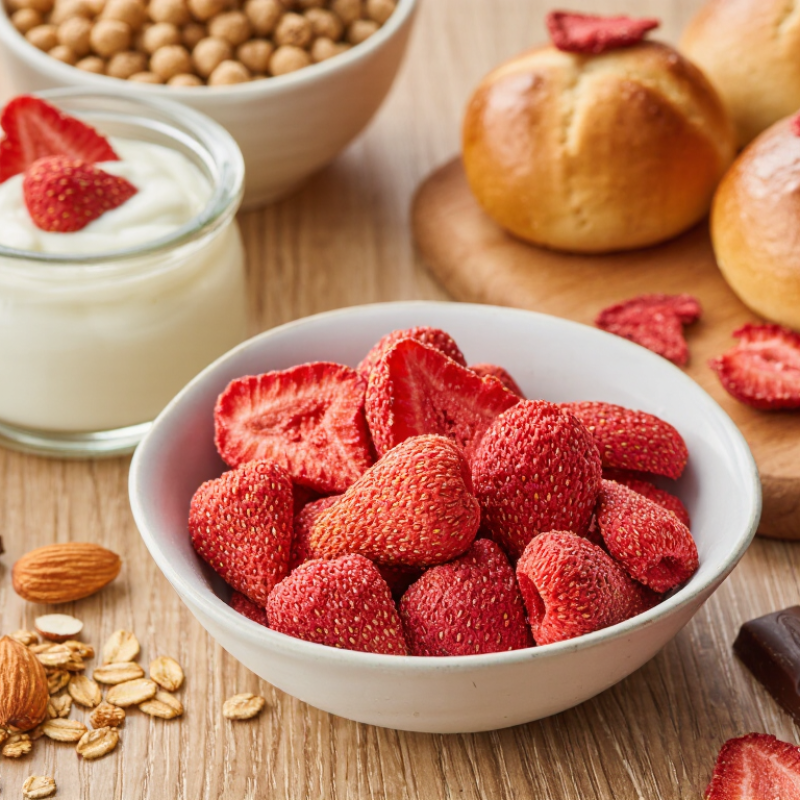
Freeze-drying protects strawberries through sublimation. The fruit freezes first, then enters a vacuum chamber. Ice changes directly into vapor, without becoming liquid. This limits cell collapse and helps preserve the berry’s shape, color, aroma, and crisp bite. USDA FoodData Central lists raw strawberries as about 90.95% water. That high moisture explains why fresh berries soften quickly. Removing ice gently can extend usability for cereals, bakery fillings, snacks, and beverage toppings.
The process is powerful, not perfect. A 2022 review in Foods reports that freeze-drying generally retains more nutrients and sensory quality than many heat-based methods. However, oxygen, light, and humidity can still damage the finished fruit. A bright red slice may hide fading aroma. Careful packaging matters. Monitor water activity, residual moisture, seal strength, and storage temperature. Use validated specifications, not guesswork. FAOSTAT reported approximately 9.6 million tonnes of strawberries worldwide in 2022, showing the scale of raw-material demand and the value of reducing seasonal waste.
Tips: Freeze uniformly sized berries for more even sublimation. Keep chamber pressure and shelf temperature stable. Test texture after packaging, not only after drying. Slightly imperfect pieces are normal, but excessive browning signals process or storage problems. Record each batch. Small details reveal large losses.
Why Choose Freeze-Dried Strawberries for Your Business?
USDA FoodData Central reports 32 kcal and 58.8 mg of vitamin C per 100 g of fresh strawberries. Fresh fruit also contains nearly 91 g of water. That water creates weight, pressure, and spoilage risk during distribution. Freeze-drying removes moisture under low-temperature vacuum conditions. The result is lighter, crisp, and easier to store.
The comparison is not perfectly fair. A 100 g portion of freeze-dried strawberries is far more concentrated than 100 g of fresh fruit. Calories and nutrients appear higher by weight because water has been removed. Vitamin C can also decline during processing and storage. Packaging quality, oxygen exposure, and storage temperature matter greatly. Businesses should request current laboratory testing, not rely only on supplier claims.
FAO reports identify perishability as a major contributor to food loss across supply chains. Freeze-dried fruit can reduce handling pressure and support longer inventory planning without refrigeration. It works well in cereals, bakery mixes, snack packs, and beverage powders. The texture remains distinctive. It is crunchy, porous, and visibly colorful.
Still, it is not fresh fruit. That matters.
From a product-development perspective, the strongest value is consistency. Each piece delivers similar flavor and measurable solids throughout the year. USDA data offers a reliable fresh-fruit benchmark, while batch testing confirms the finished ingredient’s actual nutrition. Small errors can become expensive claims.
Freeze-dried strawberries offer bright color, crisp texture, and a long storage potential. Their low moisture supports lighter shipping and easier portion control. However, moisture content alone does not show whether a product remains stable. Water activity measures available water, which microorganisms can use for growth.
The FDA commonly identifies 0.85 water activity as an important safety threshold for food control. Products below this level generally present lower growth conditions for many bacteria. It is not foolproof. Yeasts, molds, packaging failures, and poor handling still require attention. Treat 0.85 as a control point, not a universal guarantee.
A practical quality program should test each production lot with a calibrated water activity meter. Record the results, product temperature, and testing date. Then inspect sealed pouches for pinholes, weak seals, or trapped air. Small leaks matter. Once opened, strawberries can absorb humidity quickly, especially in warm storage rooms. A resealable package and a clear storage instruction can protect texture and reduce waste.
In daily operations, measure samples after processing and again during shelf-life checks. Results may vary between whole berries and crushed pieces. That difference deserves review. A slightly softer batch may signal incomplete drying, packaging delay, or seasonal variation in the fruit. Careful records help businesses adjust drying cycles without relying on appearance alone.
Why Choose Freeze-Dried Strawberries for Your Business?
Business Value: Longer Shelf Life, Lower Waste, and Easier Inventory Handling
Freeze-dried strawberries can remain usable for months when sealed properly and stored in a cool, dry place. Their low moisture content slows spoilage and protects texture better than fresh berries. For cafés, bakeries, and food manufacturers, this creates more predictable purchasing. A sealed pouch can wait on the shelf without immediate refrigeration. However, packaging quality still matters, and poor sealing can quickly reduce product performance.
Lower waste is another practical advantage. Staff can measure a small amount for cereal, dessert toppings, fillings, or beverage decoration. Unused berries do not spoil overnight like fresh fruit often does. This helps businesses control ingredient costs during slower sales periods. It also supports more consistent portioning across different shifts. In my experience, that consistency is valuable, but it requires clear handling instructions.
Inventory management becomes simpler because the product is lightweight, shelf-stable, and easy to store in labeled containers. Teams can rotate stock using receiving dates and best-before information. Less refrigerator space may also improve workflow in compact kitchens. Still, freeze-dried berries are fragile and can absorb moisture after opening. A resealable container is useful, though not perfect. Some businesses may need to test portions, packaging, and customer demand before changing their full purchasing routine.
Freeze-dried strawberries typically offer a much longer unopened storage window than fresh strawberries, helping businesses reduce spoilage risk, simplify stock rotation, and maintain a more stable ingredient inventory. Fresh berries commonly last about 3–7 days under refrigeration, while properly packaged freeze-dried fruit can remain shelf-stable for approximately 12–24 months. Actual performance depends on packaging, moisture exposure, and storage conditions.
Reference basis: commonly reported storage ranges for fresh and freeze-dried fruit; values shown use midpoint estimates for comparison.
Why Choose Freeze-Dried Strawberries for Your Business?
Consumer demand is shifting toward convenient, shelf-stable fruit ingredients. Freeze-dried strawberries meet that need without refrigeration. Their crisp texture, bright color, and concentrated flavor suit cereals, snack mixes, bakery fillings, beverage powders, and dessert toppings. They are also lightweight, which can simplify storage and shipping. For manufacturers, this creates more flexible product planning.
The market opportunity is practical, but not effortless. Buyers increasingly check ingredient labels, sourcing records, moisture levels, and microbiological testing. A reliable supplier should provide clear specifications and consistent particle sizes. In product trials, even small differences in water activity can affect crunch and shelf life. Packaging matters too. Poor moisture protection can turn crisp pieces soft within days. That detail is easy to underestimate.
Tips: Test several sizes before scaling production. Use moisture-barrier packaging and sealed storage. Compare flavor after processing, not only before it. Keep batch records. A simple tasting panel can reveal problems early. Avoid promising unlimited shelf life; conditions still matter. Pricing can also change with harvest quality, so a backup supply plan is sensible. The opportunity is strong, though careful testing remains necessary.
| Business Dimension | Verified Data or Typical Range | Why It Matters for Buyers | Practical Commercial Opportunity |
|---|---|---|---|
| High water removal potential | Raw strawberries contain approximately 90.95 g of water per 100 g edible portion. | Removing most moisture significantly reduces the weight of the ingredient while retaining the fruit’s structure and flavor profile. | Suitable for lightweight snack products, toppings, inclusions, and dry ingredient mixes. |
| Shelf-stability advantage | Commercial freeze-dried fruit is commonly produced to a low-moisture specification; final shelf life depends on moisture, oxygen exposure, packaging, and storage conditions. | A dry ingredient can be stored and transported without refrigerated distribution when the product is properly packaged. | Expands supply options for e-commerce, pantry products, export shipments, and ambient retail channels. |
| Water activity control | The U.S. FDA Food Code uses 0.85 water activity as an important regulatory threshold for controlling the growth of many pathogens; manufacturers typically target substantially lower activity for crisp dried fruit. | Low water activity helps maintain crispness and reduces the risk of moisture-related quality problems. | Creates demand for moisture-barrier pouches, desiccants, nitrogen flushing, and controlled storage procedures. |
| Reduced cold-chain dependence | Freeze-dried strawberries are a dry ingredient and generally do not require frozen transport after processing, provided packaging and storage requirements are met. | Avoiding frozen distribution can simplify inventory planning and lower handling complexity. | Useful for manufacturers serving multiple regions or operating outside major refrigerated logistics hubs. |
| Lightweight logistics | Because most of the original fruit water is removed, freeze-dried strawberries weigh substantially less than fresh strawberries of equivalent fruit content. | Lower product weight can improve handling efficiency and reduce the amount of water transported through the supply chain. | Supports ingredient sales in compact formats such as flakes, pieces, slices, and powder. |
| Texture and visual appeal | Freeze-drying generally preserves a porous structure, allowing the fruit to remain light, crisp, and visually recognizable when protected from humidity. | Visible fruit pieces can improve perceived quality and provide an authentic fruit experience. | Strong fit for cereal, granola, confectionery, bakery decoration, yogurt toppings, and premium snack applications. |
| Ingredient versatility | The same fruit can be supplied in multiple formats, including whole pieces, slices, granules, and powder. | Different particle sizes support different manufacturing processes and finished-product textures. | Enables one ingredient platform to serve snack, beverage, bakery, dairy, dessert, and supplement manufacturers. |
| Simple label potential | A single-ingredient freeze-dried strawberry product can be formulated without added oil or artificial flavor, subject to the product specification and local labeling rules. | A short ingredient declaration can support clean-label positioning when the product meets applicable regulatory requirements. | Creates opportunities for natural snack lines, simple-ingredient recipes, and transparent product claims. |
| Storage sensitivity | Freeze-dried fruit is hygroscopic and can rapidly lose crispness after exposure to humid air. | Packaging performance and resealability directly affect consumer experience and product waste. | Value-added packaging, portion packs, resealable formats, and humidity-control solutions can differentiate an offer. |
| Quality and compliance requirements | Commercial buyers commonly require documented controls for moisture, water activity, microbiological safety, allergens, foreign materials, traceability, and pesticide compliance. | Consistent documentation reduces approval barriers for food manufacturers and institutional buyers. | Suppliers can compete through lot-level testing, standardized particle sizes, certificates of analysis, and reliable traceability. |
With our award-winning goldsmiths, the end result will be a tailor-made heirloom you and your loved ones will treasure for generations. Together we walk through the design process. We listen to you carefully. Discuss what you want and what you don’t, and provide an excellent collaborative experience to bring your vision to life.
From the moment you walk in, you are treated like family. We will make your jewelry shopping experience easy and help you find the perfect piece.